A Brief Biography of Benjamin Hoskins Paddock Jr.
"I got away with an awful lot"
Benjamin Hoskins Paddock Jr., Psychiatric Review 11/6/1960 [19]
Sheboygan, Wisconsin
1926 - 1940: A Brief Family History
Benjamin Hoskins Paddock Jr., was born November 1st, 1926, in Sheboygan, Wisconsin. His parents were Olga Gunderson, the second youngest of four sisters, and Benjamin Hoskins Paddock Sr., a salesman and later Quartermaster in the U.S. Army. Benjamin's parents, being much older than average parents at the time of his birth, had little control over the young boy, and he grew up in what we can largely assume was a dysfunctional household. In a 1960 psychiatric review, he describes himself as driving by the age of twelve, dropping out his freshman year of high school, and generally boasts about his unwillingness to accept discipline as a child.
"I got away with an awful lot. I went where I felt like it, disrupting everybody's schedule"
Later, at approximately the age of seven, the family would briefly relocate to Superior, Wisconsin, before settling in Chicago around 1940.
Chicago, Illinois
1940 - 1956: The Start of a Life of Crime
After briefly living in Superior, Wisconsin, the Paddock family would relocate to the great Chicago, Illinois, sometime around 1940. According to a United States census record at the time, the family was living in Chicago City, Ward 34, Block 2, House Number 4753[1]. In 1941, Benjamin would drop out of high school and enlist in the Army. Notably, his father would also join alongside him, serving as a Quartermaster. Benjamin's enlistment in the army would not last long, less than a year, in fact. After approximately eight months, he was given the opportunity to resign without getting a dishonorable discharge and would take the rare opportunity while he had it. "They found out I just wasn't going to do what they wanted me to do," Benjamin later said of his time in the Army. Following his resignation, Benjamin returned home to Chicago and enjoyed a few months of coddling from his parents. After this, he would depart on his next adventure, spending the summer 1943 or 1944 with his aunt in Los Angeles, California. While staying in California, Benjamin earned his wages working as a bus driver for the L.A. railroad company. While working this job, Benjamin would enjoy his weekends taking the buses out for rides with his co-workers. Like his time in the military, this would soon be cut short as he was fired for failing to report an accident [108].
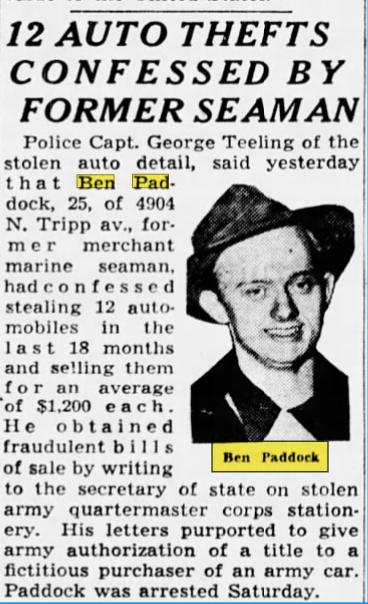
While it's not entirely clear when Benjamin began his life of crime, the earliest record I have is from just after his return home from Los Angeles. On January 8, 1946, at approximately age 18, he would be arrested for the theft of 12 cars over the previous year. Notably, the method of theft involved using stolen Quartermaster stationery from his father, writing fictitious bills of sale claiming they were Army cars [2]. This arrest would lead to Benjamin being sentenced to five years in "Old Joliet," the Stateville Correctional Center, in Joliet, Illinois. This sentence would eat away much of Benjamin's formative years. Stateville was built using a panopticon architecture, with circular pods containing centralized guard towers with direct lines of sight into each cell. Under Warden Joseph Ragen's tenure, the prison would undergo many changes including the implementation of education programs that offered college courses and training for common trades. Activities among those imprisoned there included work programs, reading, radio listening, and card games. Given Benjamin's later legal troubles involving several different bingo parlors, one can only imagine the influence this time had not only on his life, but on his son's as well. During his psychiatric interview, Benjamin would describe his time in Joliet as "real rough" and claimed he had spent the last two years of his sentence in solitary confinement. Given Benjamin's track record and knack for lying, it's not known if this is another one of his tall-tales or the truth.
Shortly after his release from his five-year sentence in 1951, Benjamin would soon thereafter marry his first and only wife, Dolores Irene Hudson. The couple was married on July 16, 1952, at the First Methodist church in Reno, Nevada [3]. Seemingly, the first of many times the Paddock family would wind up in Nevada. Despite this marriage and the prospects of fatherhood ahead of him, Benjamin had no intention of leaving behind his criminal lifestyle. While there are newspaper clippings and articles that claim he was working as a used car salesman, during his time in prison Benjamin had met his future partners in crime "a couple guys from Kansas City", later forming a "Father & Son" robbery and check fraud gang. Because of this, it is entirely possible that the "used" cars that Benjamin sold were stolen merchandise, although, that is not proven.
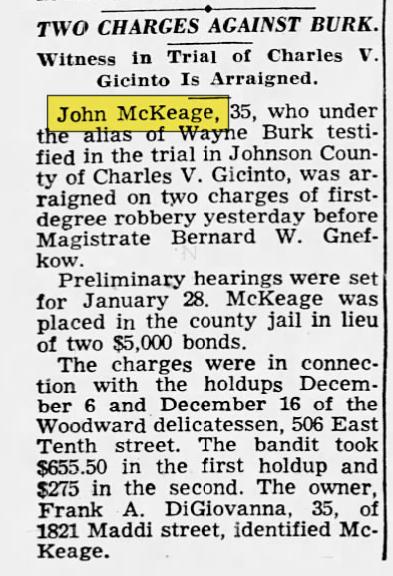
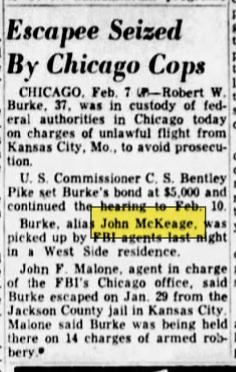
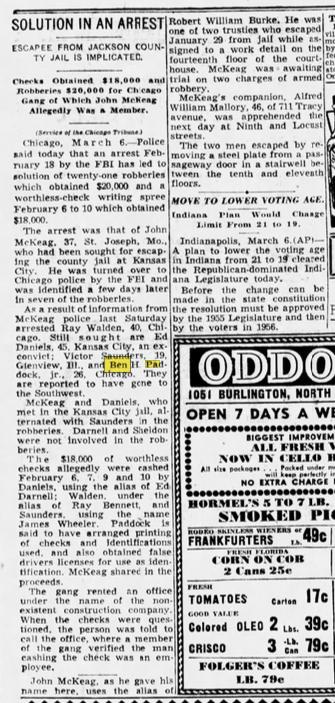
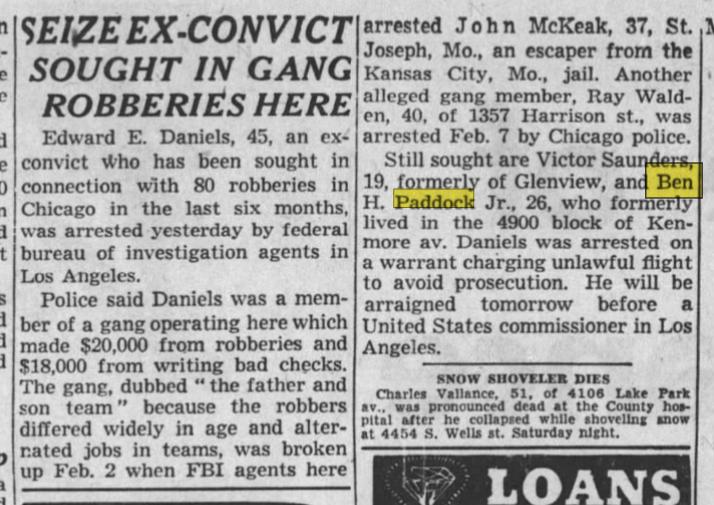
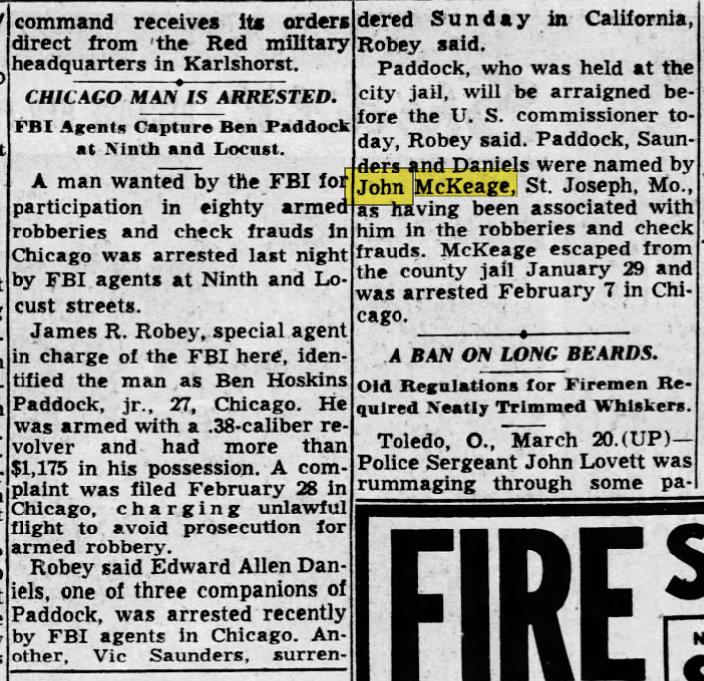
Operating since at least 1952, the Father & Son gang consisted of John McKeage, Edward E. Daniels, Ray Walden, Victor W. Saunders Jr., and Benjamin Hoskins Paddock Jr. The gang was dubbed the Father & Son gang due to the differing ages of the members, along with their practice of alternating which members served as the "father", with Victor filling the role of the "son" in their robberies. Benjamin mostly assisted the group through the printing of bad checks and false identification. The men would primarily make their money from robberies, of which they were ultimately accused of twenty-five. From their robbery scheme, the gang made approximately $20,000 (~$240,000 at the time of writing), but that was not their only source of income. The gang would also engage in a large-scale check fraud scheme, passing over sixty bad checks totaling $18,000 (~$215,000). The group operated out of 55 E. Washington St., better known as the "Pittsfield Building", a thirty-eight-story high-rise and a city landmark of Chicago, under the false name "Butler-Nordstrom Construction Company". Their crime spree would not go unnoticed for long, as the group quickly found themselves under investigation from both the police and FBI, starting with McKeage, in January of 1953 [4]. McKeage would soon escape from jail and be caught by the FBI again in February of 1953 [5]. After McKeage, the next to fall would be Walden in February of 1953, then Daniels in March of '53. Soon after, Benjamin and Saunders would find themselves busted as well. According to a newspaper clipping from March 20, 1953, when Benjamin was caught, he was accused of eighty robberies and was caught with a .38 revolver and $1,175 cash on him [6,7,8,9].
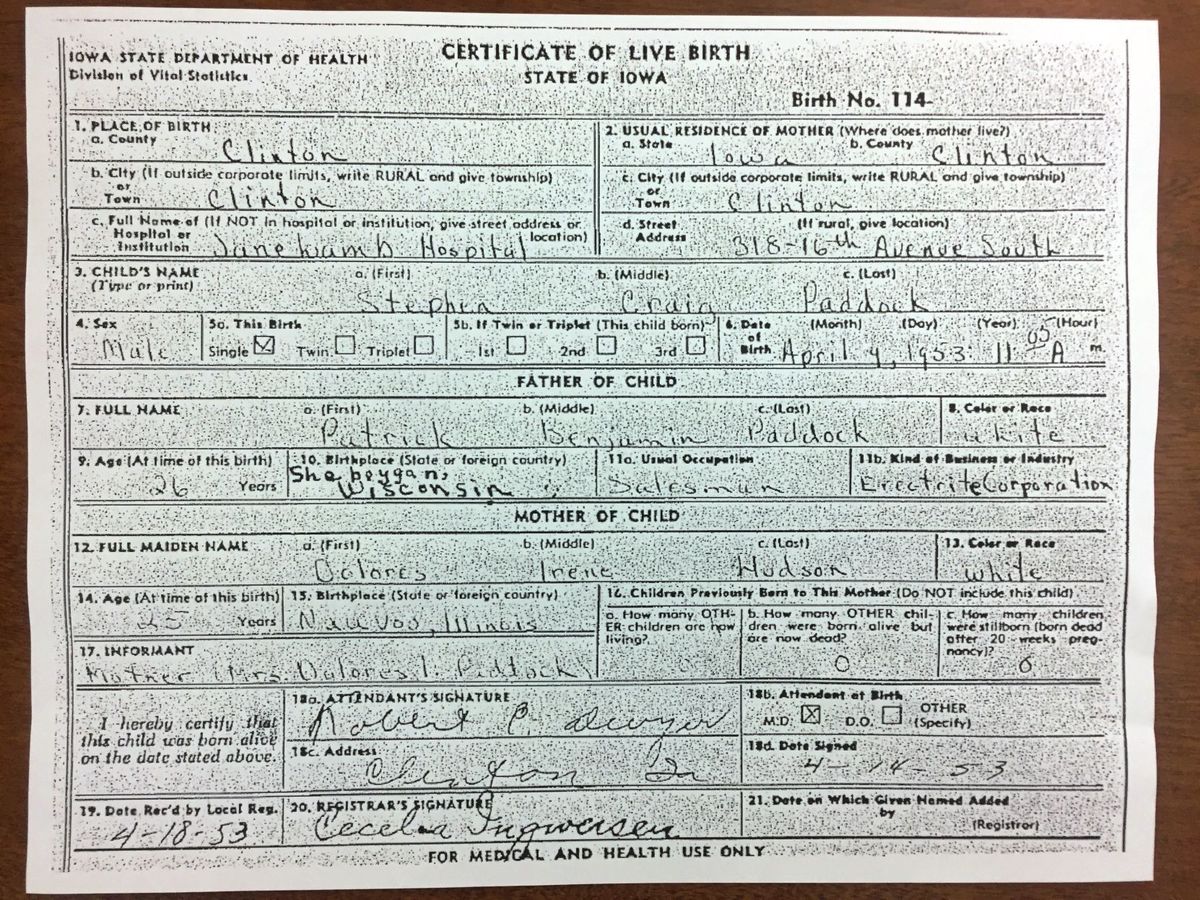
In the midst of his crime sprees and imprisonment, Benjamin and Dolores would have their first child, Stephen Paddock, on April 9, 1953, at the Jane Lamb Hospital in Clinton, Iowa [10]. An examination of Stephen's birth certificate reveals some interesting details regarding Benjamin and Dolores' life at the time. While a later newspaper report on his sentencing would list Benjamin's address as 4909 Kenmore Ave. in Chicago, Stephen's birth certificate lists his and Dolores' residence as 318 16th Avenue South in Clinton. This address at the time of Stephen's birth would not be registered to Benjamin and Dolores, but instead to a couple named Howard and Doris Ayers. Howard and Doris being Benjamin's in-laws, as Doris was Dolores' sister. It appears that the young Benjamin and Dolores may have been staying with family while on the run. Additionally, of note is that Benjamin signs his name "Patrick Benjamin Paddock", this being the first of many pseudonyms that he would use throughout his life and criminal career. Along with this, Benjamin listed his occupation as a salesman for "Erectrite Corporation," a job his father once held before him. Whether this is true or not is unknown, but Benjamin would have several sales related jobs throughout his life.
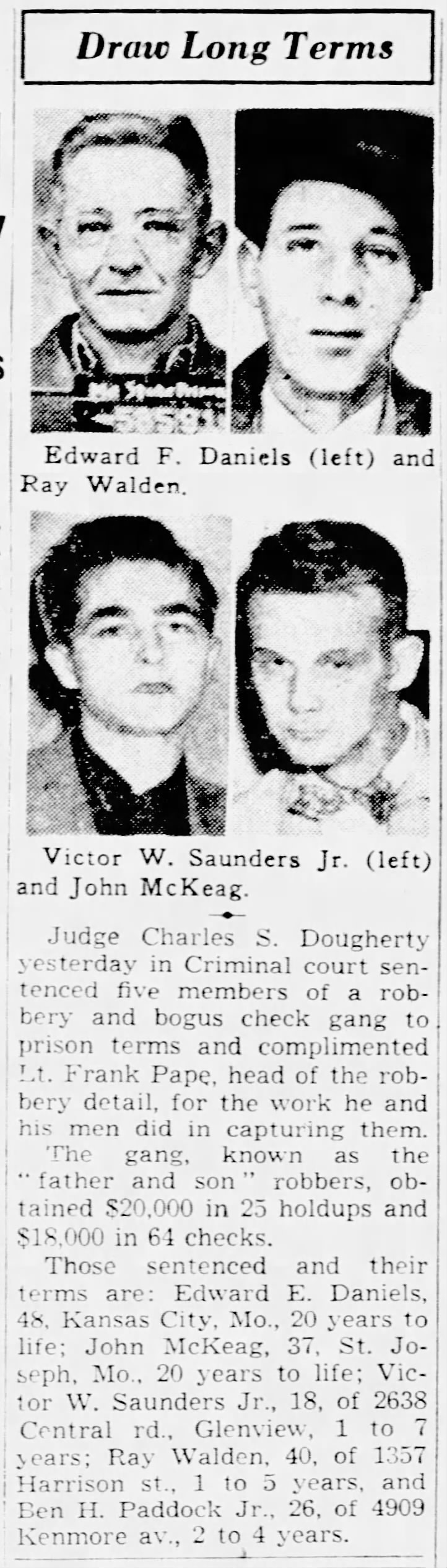
Benjamin's time with the infant Stephen would soon be cut short, as the gang would finally be sentenced in June of that year. The gang would ultimately face varying lengths of imprisonment, with Daniels and McKeage getting the longest sentences at twenty years to life, and Benjamin with the shortest at just two to four years [11]. This arrest would send Benjamin back to the same prison walls he was all too familiar with, Old Joliet. Benjamin's second stay in Joliet would seemingly be better than his first stay. He later claimed in his psychiatric interview that he had cut it out with the warden of the prison, "I got along all right. I made a deal with the warden - you leave me alone and I won't cause you any trouble." During this time in prison, the young Dolores was left to raise the infant Stephen on her lonesome. According to records at the time, she worked as a secretary as her main form of income. It is also possible that she received help from her sister, who was living in Clinton, Iowa, at the address listed on Stephen's birth certificate.
Tucson, Arizona
1956 - 1977: Big Daddy & The FBI
Ultimately, Benjamin would serve just about three years of his sentence before being discharged. Fresh from prison and ready to leave behind the troubles of the past in Chicago, the Paddock family would follow in the footsteps of their in-laws, the Ayers, and pack their bags for Tucson, Arizona, in August of 1956. Of his time in Chicago, Benjamin would say, "There was no challenge left. The thrill had gone out of it". Determined to move on, the Paddock family would pack their bags and take the three-years-old Stephen to their newly purchased property at 1122 N. Camino Miraflores, Tucson, Arizona.
This short period in Tucson, lasting from 1956 to 1960, would be the only true "stable" time of Stephen's childhood. As described in an article from the July 29, 1960, Tucson Daily Citizen, during this time Benjamin had made a name for himself in the Tucson area by working a wide variety of jobs, eventually earning himself the nickname "Big Daddy". From operating a filling station they had purchased along with their house, to owning a garbage disposal sales business, volunteering as a special deputy at the local sheriff's office under Sheriff Walden Burr, to even operating the "Big Daddy" nightclub at 2849 N. Avenue in the later years, Benjamin appeared to be constantly busy with work. In his free time, he became the vice-president of a local hot-rodders club and learned about amateur radio, receiving his Federal Amateur Radio Operator's license. Benjamin would use his radio experience to further assist his volunteering efforts with the Sheriff's office search and rescue squad. As described by his peers in the newspaper, Benjamin, "bulged with sincerity" . . . "He seemed like the average middle-class businessman, devoted to his home and family." [15] Benjamin's hot-rodding and radio obsession would culminate in his Achilles heel, a 1960 Pontiac, fitted with what he described as the ham radio equipment "ideal for a burglar or robber, because the operator could monitor the police calls and FBI messages, etc.". As one could imagine with all the radios, antennas, and gear rigged in this car, it would stick out like a sore thumb.
During this period of stability, "Big Daddy" and his wife Dolores would have their remaining children: Patrick, Bruce, and Eric. Patrick, born in 1957, is largely a career military man, who at various points worked to train NATO and non-NATO troops overseas according to his LinkedIn. Bruce, born in 1959, would largely live as a transient, earning several criminal charges before passing away in November of 2020. And lastly, Eric, born in March 1960, was a longtime employee and early part of American database analytics company Teradata, earning him the nickname "teraeric".
These four years, while being the only period of stability for the young Stephen, were only a temporary phase between Benjamin's prison sentences. Benjamin, unable to escape the life of crime and needing funds for the growing family, would hold up three branches of the Valley National Bank in Phoenix, Arizona. The first would take place in February of 1959, with a potential second robbery in October of 1959 that he seemingly was never charged for [12,13]. The last two robberies were in January and July of 1960. The Arizona Republic newspaper describes Benjamin's actions during his return robbery in February of '59: "A well-dressed gunman who identified himself as a representative of a "collection agency". . . "he was described as cool and collected, almost like a professional," before escaping in a stolen getaway car, later abandoned for his trusty Pontiac, netting him about $11,000 dollars [12]. The final hold-up in July of 1960 would result in him getting caught and arrested by the FBI. In this final hold-up, Benjamin would attempt to flee the FBI in his Pontiac fitted with his custom radio gear and eventually get caught in downtown Las Vegas. After being cornered, in a desperate last attempt to flee, he would prepare to run down an FBI agent but called it quits after a shot was fired through the windshield of his vehicle. According to the FBI, at the time of his arrest, Benjamin had a loaded revolver, a blackjack, and a considerable amount of cash [14,15,16].
According to newspaper reports, on the day of Benjamin's arrest, the FBI raided the family home in Tucson. The Paddock family's neighbors, Eva Price and Mary Jacobs, assisted the now lone Dolores by taking the young Stephen swimming and watching the other three children while the FBI rifled through the home's contents. In the months following Benjamin's arrest and before his trial starting at the end of the year, Dolores would relocate the family for the final time. The now single mother, sometime around August of 1960, would pack their belongings and head for the Sun Valley neighborhood of Los Angeles, California [107].
Stephen, graduating in '71 from John H. Francis Polytechnic High School, was described by his brothers and classmates as being the boring one of the family, quiet, withdrawn, and seemingly a math whiz. While outwardly not the troublemaker of the family, according to LVMPD interviews with his ex-wives, Stephen would later confess that growing up with his single mother and financial instability would cause him to become self-reliant and self-sustaining. Interestingly, while many newspapers and articles cite Dolores sustaining the family on a secretary's wage, Bruce, the middle child, provides a seemingly forgotten detail in an interview on the Jim Breslo "Hidden Truth Show" podcast. During the interview, Bruce Paddock details that Dolores may have made more money than previously known, being partner in a US military manufacturing firm producing aircraft parts such as telemetry electronics and thermal couples. He states "My moms always worked for a living. She worked for SEMCO, Scientific Engineering." When asked "But as a secretary, right?" Bruce responded, "yeah, well she was a partner, ended up being a partner taking a bunch of the stock." [106]
While the Paddock family was away in California, in Phoenix Benjamin was under psychiatric review just before his trial. On November 6, 1960, Doctor William B. McGrath would interview Benjamin at the Maricopa County Jail. Benjamin would describe himself as a "third time loser", referring to his previous sentences. McGrath describes the then thirty-four-year-old Benjamin as a large, confident, commanding presence, seemingly unaffected by the charges levied against him. Throughout this interview, Benjamin elaborated on his life to McGrath before they eventually reached the subject of the charges which had recently been placed against him. In a seemingly odd turn, Benjamin insisted that the bank robberies were simply a case of the wrong identity. McGrath states: "He tells, more or less confidentially, of his dealings with "the syndicate," on account of which he must not really attempt to defend himself or to disclose to the court the identities of those who took his car and presumably committed the armed robberies." By the end of the interview, McGrath determined Benjamin had a sociopathic personality [19].
Newspaper clippings from December of 1960 described the ongoing trial for the bank robbery [20,21]. The papers describe Paddock being identified along with his notable vehicle. One of the witnesses at the trial, a William Carl Otto, describes installing Benjamin's vehicle with the necessary radio equipment, believing he was a member of the Sheriff's rescue unit. FBI agent Ernest Van Loon describes him confessing, "I shouldn't have run (after the robbery). I got myself into this mess, and I deserve what I got. . . It was obvious that if I didn't commit the robbery, I must have had some connection with it." He later elaborated, attempting to deflect blame, "Another ham operator in Arizona has a car with aerials similar to mine."
As the trial continued into January of 1961, an associate of Benjamin's, Helen Kuzmanoff, would be called as a witness. Kuzmanoff, according to her obituary [101], was a Macedonian immigrant and owned/operated sixteen different bars in Arizona. Throughout the '50s, Kuzmanoff would take an active part in her local Democratic Party and would run for Phoenix city council in the '60s. Kuzmanoff would testify on behalf of Paddock, testifying that he had been negotiating to purchase a liquor license with her at the time he was accused of his last robbery. The cash Paddock had on hand at the time of his arrest was supposedly payment for the license, not cash from the bank. Why a seemingly respectable, innocent, woman would be involved in the life of such an eccentric man as Benjamin's is unknown.
Ultimately, the trial would conclude on January 5, 1961. Benjamin would be sentenced to twenty years in prison, to serve his time at the Federal Correctional Institution (FCI) La Tuna in Anthony, Texas [22,23,24]. During his stay at FCI La Tuna, Benjamin would attempt to appeal his case twice. The first, in 1962, would be immediately rejected for not following proper procedures. In the second appeal, in July of 1963, Benjamin would claim an unfair trial due to comments allegedly made about his court-appointed attorney. This appeal would also be rejected, and the court upheld Benjamin's conviction [25,26].
Benjamin, after serving nearly eight years, unable to appeal his case and facing life in prison, decided to take matters into his own hands and escape the prison. While the subject of debate, on December 31, 1968, Benjamin would simply walk out of the prison while out for work. According to a 1979 interview with the Eugene Register-Guard, Benjamin described his escape: "while working on a work farm 'I just paroled myself.'" [88] he claims. How the six-foot-four, 250-lb.+, bald, towering presence of a man escaped unnoticed, is left to the imagination.
In the months immediately following his escape, Benjamin would make his way out of Texas and up the west coast of California, presumably visiting his family now living in the Sun Valley area of Los Angeles along the way (although this is not known), before continuing up to San Francisco. On the run and needing money, Benjamin would fall into his old habits and be accused of robbing two banks in the area, although, little is known about these robberies [29,30,31,32,33,34,35].
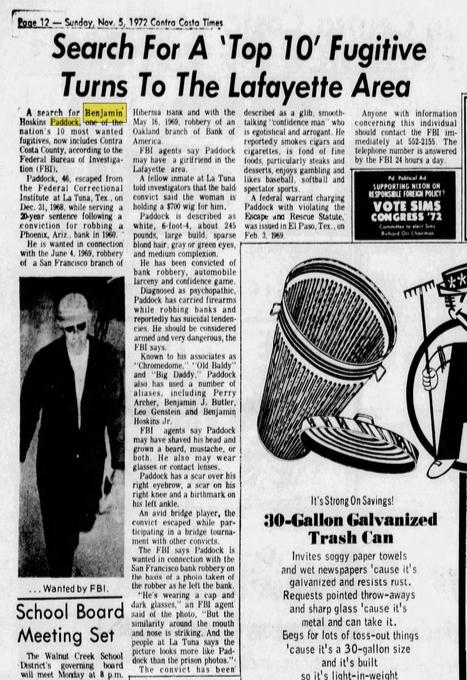
Not long after Benjamin's escape and trip up the west coast, in February of 1969, Benjamin would have a federal search warrant placed on him, and in June would be added to the infamous FBI "Most Wanted List." Being placed on the list in June of 1969, Benjamin would be one of the longest-lasting criminals on the FBI's notorious list, lasting over seven years before his removal from the list in mid-1977. Later newspapers would show the FBI was seeking information from radio and automotive clubs to get more information on Benjamin. The FBI memorandum released as he was placed on the list reads:
"tall and heavy at 6'4" and 245 pounds, Paddock may have completely shaved his blond balding head. He has used nicknames "Big Daddy", "Chromedome", "and "Old Baldy" (other names include Perry Archer, Leo Genstein, and Patrick Paddock) and has been described as a glib, smooth-talking, egotistical, arrogant "confidence man." He likes steaks and desserts, Camel cigarettes, Dutch Master cigars, television, sports, gambling, bridge, hot rod and stock car racing and ham radio operation. He has worked as an automobile mechanic, electrician, promoter, salesman and service station, nightclub and driving school operator. . . He has been diagnosed as a psychopath and may have suicidal tendencies." [36,37,38,39,40,41,42]
Eugene, Oregon
1977 - 1988: Bingo, the CIA, Ford Foundation, and more, oh my
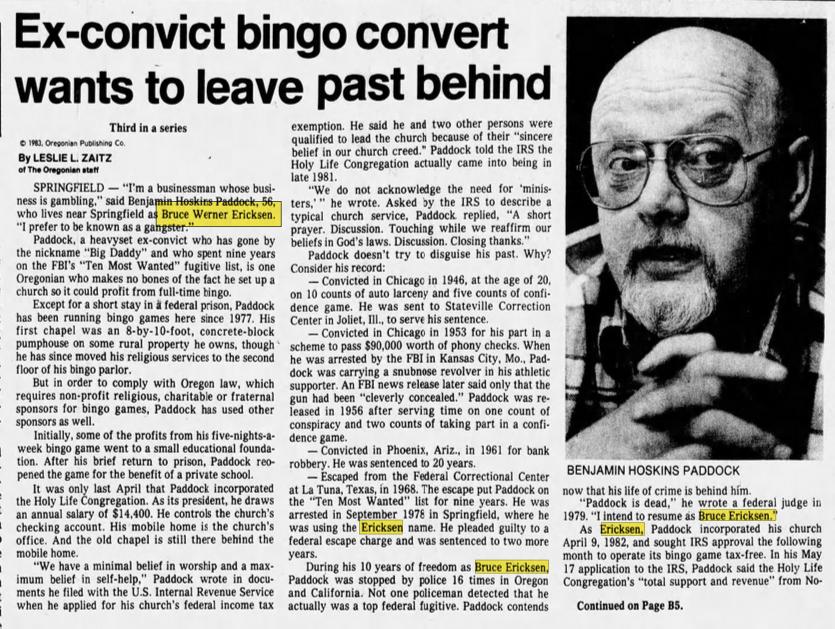
Following his brief stop in San Francisco, Benjamin would make his way over to the Eugene, Oregon, area where he would settle for quite some time. On the run, Benjamin would decide to assume another identity and leave "Benjamin" behind, moving forward as "Bruce Werner Ericksen," or as he would become better known, "Bingo Bruce." In a later 1979 Interview with the Eugene Register-Guard reflecting on this time, Benjamin states: "My name is Ericksen now . . . Paddock is dead." [88]
During this time, Paddock would quietly build up his life in Eugene and avoid headlines outside of republished Most Wanted lists. A 1974 Sheboygan Press headline highlights this: "FBI Search Continues... Paddock: After 5 Years He's Still on 'Most Wanted' List." The article states, "Paddock's picture has been on the walls of government buildings for a long time, but obviously it hasn't done much good." [72]
For reasons unknown, it's possible that during this time Benjamin had made his way to Australia sometime between 1973-1974. According to an unclassified telegram cable from the "Office of the legal Adviser, Department of State" to the Australia Secretary of State, information was sent to all police in Australia with details on Benjamin due to his potential presence. The relevant section of the cable reads:
"ALTHOUGH MAY BE ENTIRELY COINCIDENTAL, USE OF NAME DOROTHY JEAN HOSKINS BY SUBJECT MC CORMACK BRINGS TO MIND INQUIRIES MADE IN 1973 IN AUSTRALIA AND NEW ZEALAND RE POSSIBLE PRESENCE THERE OF BENJAMIN HOSKINS PADDOCK, AKA. BENJAMIN HOSKINS, JR., AND MANY OTHER NAMES. PADDOCK IS ONE OF FBI TEN MOST WANTED FUGITIVES. DETAILED BACKGROUND DATA RE HIM PLUS IDENTIFICATION ORDERS WITH FINGERPRINTS AND PHOTOGRAPHS SENT TO COMMONWEALTH POLICE AND ALL STATE AND TERRITORIAL POLICE IN AUSTRALIA ON JULY 31, 1973. COPIES PROVIDED FOR AMEMBASSY CANBERRA AND AMCONSUL SYDNEY. NO POSITIVE RESULTS ACCRUED. SUGGEST AT TIME MC CORMACK NEXT APPROACHED. ORIGIN OF USE OF HOSKINS NAME BE DETERMINED WITH IDEA THAT SHE MAY BE ASSOCIATING WITH BENJAMIN HOSKINS PADDOCK IN AUSTRALIA." [73]
It's during this relatively quiet period of Benjamin's life that his sons Eric and Bruce would allegedly meet their father for the first time of their adult lives. As described by Bruce in the podcast interview, in what would be the first of three times he would meet his father, the two would take Bruce's truck up from the Sun Valley to Eugene for what is described as a relatively short trip. Describing it more as a "scenic venture," Benjamin met the two "on a dirt lot on the corner of the highway" near his house before taking them in. Bruce describes his disdain as Benjamin "ran his mouth about being an outlaw. He wanted to show me pictures of this and that of his life." "I wanted nothing to do with it," Bruce said. During the conversation, remarking on his disapproval for his father, he mentions Benjamin "holding up a bank to go to Vegas and have a good time."
Benjamin, starting a new life as Bruce in Eugene, would need to find ways to make money that didn't involve robbing banks. In 1976, Benjamin would again, for a short period of time, enter the used car business, opening a lot in Junction City, while also working as a truck driver at times around the area and later selling "Ericksen Special Edition" show-cars. An Oregon Supreme Court case [79] would provide insight into this time of Benjamin's life, and his next ventures that would follow him for the rest of his life. In this case, it is revealed that Benjamin would finance his car lot through connections made via his attorney, Hector Smith, who was representing him in a separate automobile accident case. Through Smith, Paddock would meet Rufus Frederick Van Deinse II, a recent heir to a large inheritance, who would loan Paddock $6,000 for his car lot. It's unknown if this money truly went to funding the car lot, as the court case describes Paddock shuttering the business soon after in 1977 before moving onto his main venture: bingo parlors.
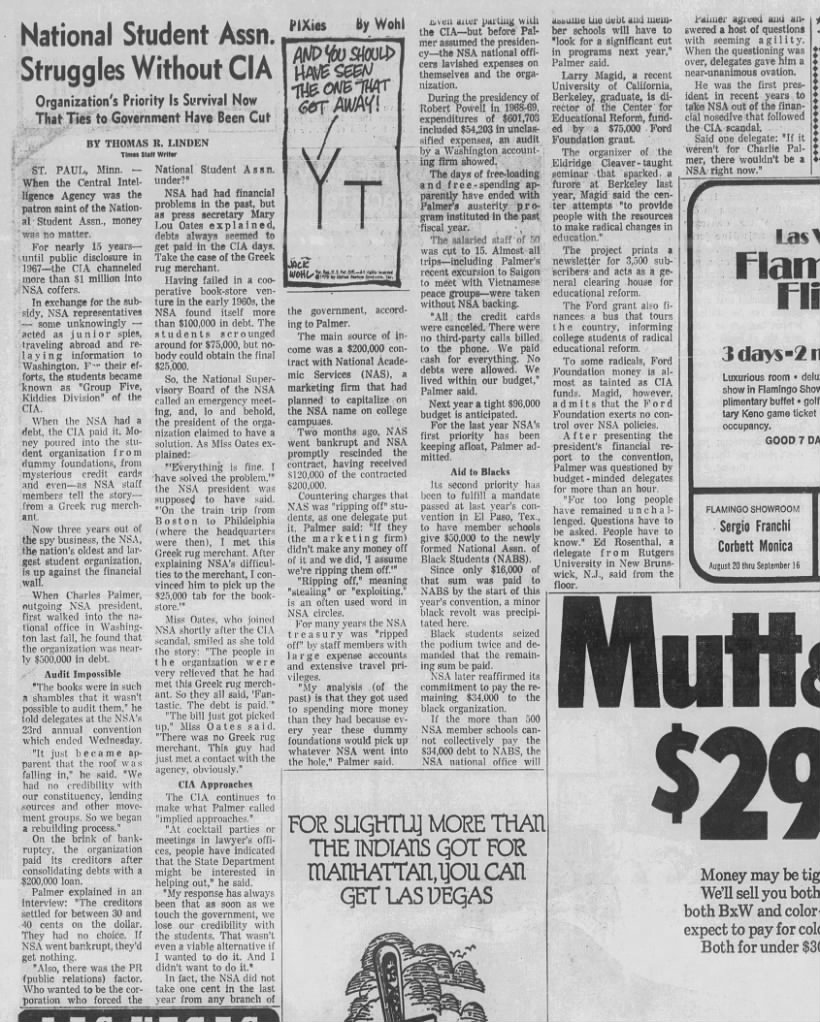
To understand Benjamin's next venture and its funding sources, it's important to examine the broader landscape of CIA-funded organizations operating during this period. Throughout the 1960s and 70s the CIA was deeply invested in infiltrating popular American culture in what can be described as a cultural cold war. A large part of this was through the funding of "philanthropic organizations" such as the Ford Foundation. The Ford Foundation, "with the stated goal of advancing human welfare", largely served as a cutout for funding various CIA operations, in this case, influencing and infiltrating left-aligned student movements in American universities. The National Student Association (NSA), a confederation of student governments across the nation, rallied students for protest and advocated for many "radical" reforms to student life, they also acted as one of the CIA's most successful domestic front organizations. As described in a 1968 New York Times article, the Ford Foundation would give $315,000 to the NSA to "enable the association to gather and publish information on various reform campaigns and hire several staff members to help student leaders press for changes on their own campuses." [27] Then president of the NSA, Edward Schwartz (elected August, 1967), would say the programs tried to "generate quiet revolutions instead of ugly ones." Dubbed the "New-Left" in media, they would become a growing "threat" to the nation and catch the eye of US intelligence agencies. It should be noted, that during the time period that Benjamin remained on the Most Wanted list, most other names alongside his were associated with "New-Left" movements [48]. Much of the NSA's ties with the CIA would come to light in a famous expose by Ramparts magazine in February of 1967, detailing the use of fronts for funneling CIA money into various cultural institutions.
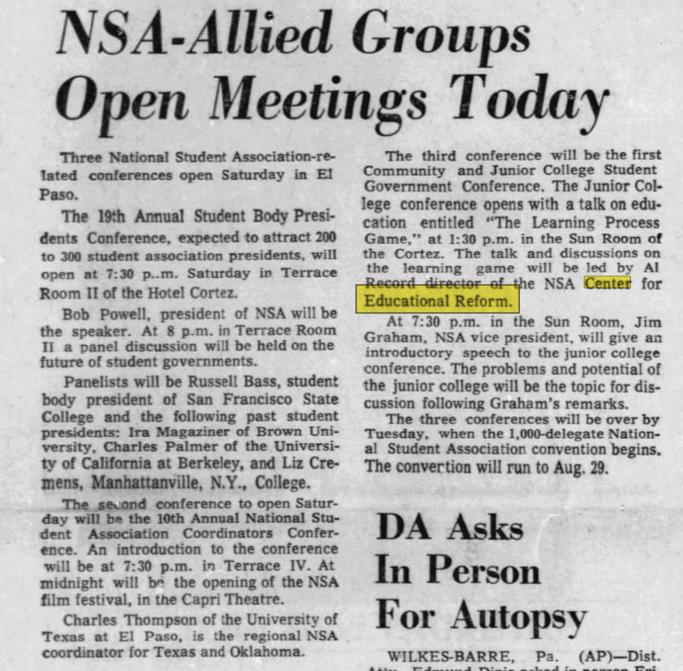
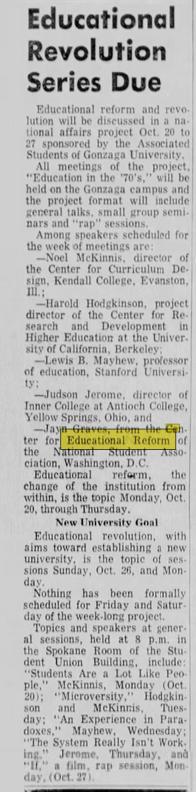
The 1968 Ford Foundation funding of the NSA would be used to form the Center for Educational Reform (CER). As described in a 1969 issue of the Purdue Alumnus magazine, "A major aim of the NSA this year is reform of the academic process. With a $315,000 grant from the Ford Foundation, the association has established a center for educational reform, which encourages students to set up their own classes as alternative models, demonstrating to the colleges and universities the kinds of learning that students consider worthwhile." [28] The Center for Educational Reform during this time would largely be headed by Larry Magid, former editor of Edcentric and director of NSA Center for Educational Reform from 1969-71 [74]. Larry Magid, according to his bio, would later work with the National Center for Missing & Exploited Children, serving on the board for twenty years. Additionally, he later "served on safety advisory boards for Meta, Google, Twitter, Comcast, Roblox, Zepeto, and Snapchat" and "served on the Obama administration’s Online Safety & Technology Working Group where he chaired the education sub-committee." [103] The CER would publish a magazine, Edcentric, described as "a journal for educational change" They would mostly publish alternative education ideas/reform messaging from the NSA/CER.
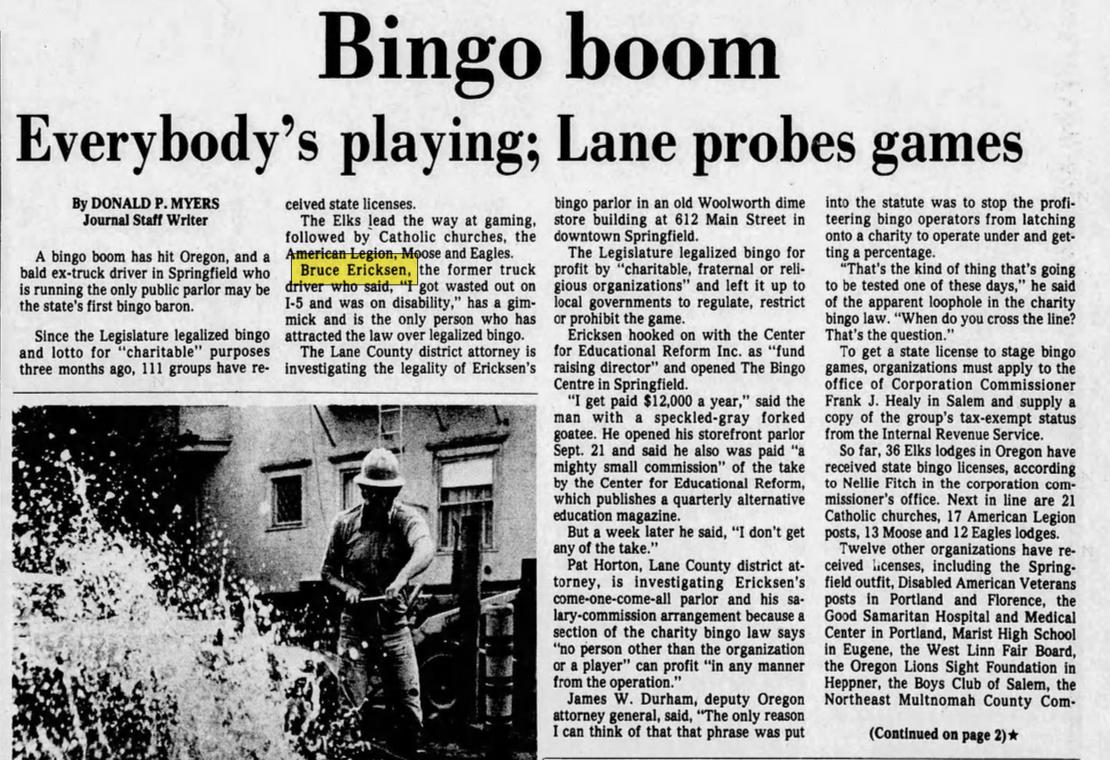
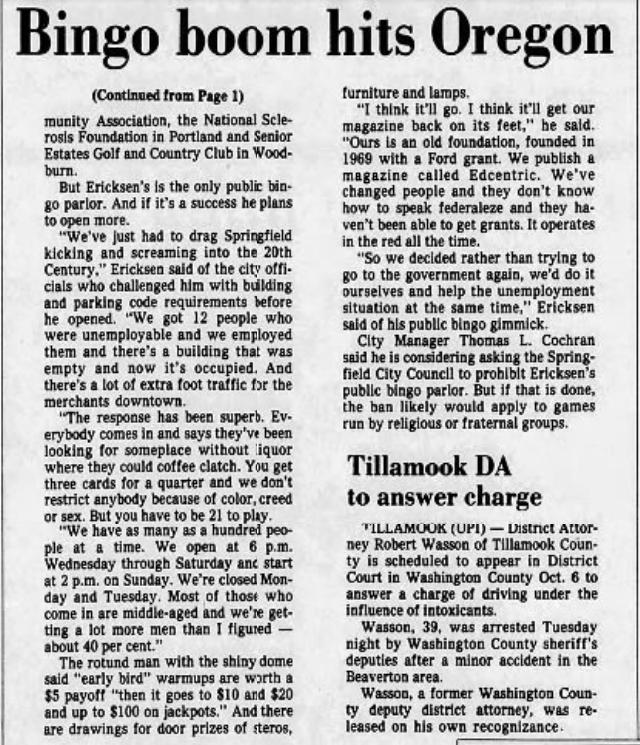
Additionally, after their initial startup funding from the Ford Foundation in Washington D.C., Edcentric and the CER would largely receive their funding from Benjamin and his bingo parlor, the Bingo Center. According to the Oregon Supreme Court case mentioned earlier [79], in June of 1977, Oregon state would pass legislature permitting "charitable, fraternal, and religious organizations to operate bingo games." Benjamin, by no coincidence, freshly removed from the FBI's Most Wanted list in May of 1977, looking for his next venture, would abuse the new legal loop-holes to orchestrate the creation of the "Bingo Center." The Bingo Center, a bingo parlor based out of 612 Main Street in downtown Springfield, Oregon opened in July of 1977. The first legal bingo parlor in Oregon, it would find its start with "Ericksen," Van Deinse, Smith, and the CER. While it's a "chicken or the egg" situation and not completely known who found who first, Benjamin's lawyer, Smith, would draft an employment contract between "Bruce Ericksen" and the Center for Educational Reform, Inc., an Oregon non-profit spin-off shell for funding of the main organization. Per the employment contract, Benjamin would be named director of the organization. Seeking startup capital for the business, Benjamin would take another loan from Van Deinse of $12,000, who would later become an employee of the Bingo Center. As described by Benjamin in an interview in the September 29, 1977, Oregon Journal, "Ericksen hooked on with the Center for Educational Reform Inc. as a "Fund raising director" and opened The Bingo Center in Springfield. "I get paid $12,000 a year," said the man . . . and said he also was paid "a might small commission" of the take by the Center for Educational Reform, which publishes a quarterly alternative education magazine." The same article later quotes Benjamin: "I Think it'll go. I think it'll get our magazine back on its feet," he said. "Ours is an old foundation, founded in 1969 with a Ford Grant. We publish a magazine called Edcentric. We've changed people and they don't know how to speak federalese and they haven't been able to get grants. It operates in the red all the time." [81,82]
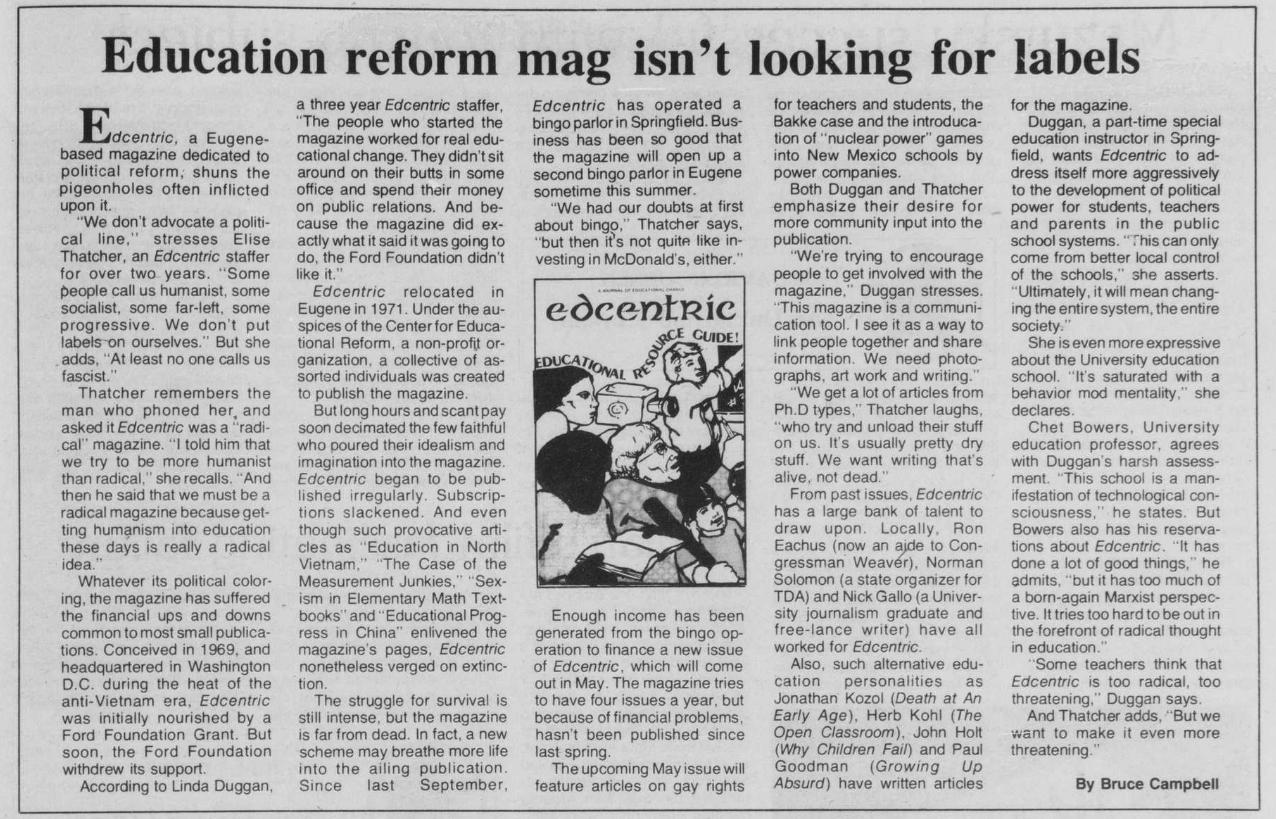
A 1978 Oregon Daily Emerald article, "Education reform mag isn't looking for labels" further details Edcentric and ties to the Ford Foundation and Bingo Center, the article states:
"Edcentric, a Eugene-based magazine dedicated to political reform; shuns the pigeonholes often inflicted upon it"
"the magazine has suffered the financial ups and downs common to most small publications. Conceived in 1969, and headquartered in Washington D.C. during the heat of the anti-Vietnam era, Edcentric was initially nourished by a Ford Foundation Grant. But soon, the Ford Foundation withdrew its support."
"Edcentric relocated in Eugene in 1971 under the auspices of the Center for Educational Reform"
"The struggle for the survival is still intense, but the magazine is far from dead. In fact, a new scheme may breathe more life into the ailing publication. Since last September, Edcentric has operated a bingo parlor in Springfield. Business has been so good that the magazine will open up a second bingo parlor in Eugene sometime this summer." [83]
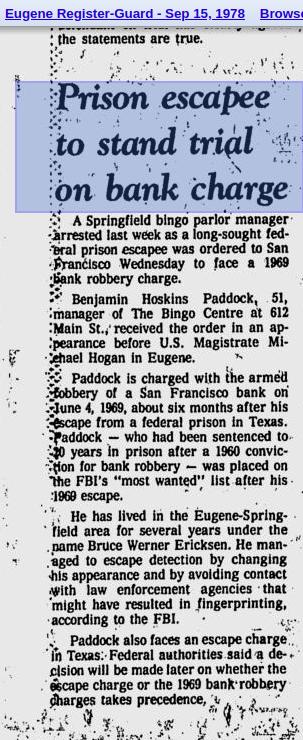
Soon after the start of his bingo ventures, Benjamin would be investigated by Lane County district attorney, Pat Horton. Lane County would start their investigation the same month they opened, in September of 1977, due to the claims of Paddock taking a salary from the operation. This being an issue, as the bingo law said "no person other than the organization or a player can profit in any manner from the operation." This investigation, paired with increasing media presence due to the bingo operation, would culminate in the arrest of Benjamin on September 6, 1978. On that day, after allegedly catching wind of Paddock's location and new identity "Bruce Ericksen," the FBI would stage a sting on the Bingo Center. An agent, posing as an upset customer, lured Paddock out of the parlor where he was apprehended by eight agents and officers. As an aside, while the newspapers of the time state Benjamin was found due to coverage/media presence, Bruce in his podcast interview states that his father told him it was his girlfriend at the time who had turned him in to the FBI. Whether this is true is unknown. [85,86,87]
The arrest of the now established "Bruce Ericksen" rocked the Eugene community. Having left behind his life of crime and the Benjamin identity, Bruce had become well respected in the Eugene area through participation in local clubs, volunteering, and, of course, his bingo operations. A 1978 Eugene Register-Guard article provides insight into the arrest and bingo operation: "Dotseth said his Eugene friends were stunned when they learned the man they met six months ago at the Eugene Elks Lodge was actually a bank robber who escaped from a Texas prison in 1969 and was on the FBI's 10 "most wanted" list for eight years" . . ."You read that in the newspaper and it's just hard to believe. . . . He was awfully nice and always very polite, casual and calm. But he always held you at arm's length. I don't suppose anybody ever did make a close friend of him." [84] Benjamin would be held in Lane County jail on $100,000 bail pending his federal court date. After the final court decision, Benjamin would be charged for the robberies in San Francisco and his prison escape. The court would add an additional two years to his remaining twenty-year sentence and Benjamin would be placed in jail for the final time at Lompoc Federal Correctional Institute, in Lompoc, California.
Locked up in Lompoc, Benjamin would only serve just four months of his sentence before being paroled in May of 1979, as he "served considerable time by federal standards" along with "adjustment, achievement, and background." Having made himself a pillar of the community, federal officials would receive over 1,600 letters and signatures petitioning for Benjamin to be released. Freshly paroled and out of prison for the last time of his life, Benjamin would again assume the name Bruce and pick-up where he left off in Eugene. Reflecting on his previous ventures and his future prospects, Benjamin would state, "The Bingo Center was an exercise of ingenuity. . . If another exercise in ingenuity comes along, I go with it." Benjamin's next "exercise in ingenuity" would again be the bingo business, this time funding his own religious organization, the Holy Life Congregation, and a religious education institution, the Delphian School of Eugene.
On October 28, 1980, in court, further reflecting on his previous charges, Benjamin also admits to several murders that he was seemingly never charged for:
Q. You had been convicted of armed bank robbery?
A. Yes.
Q. That you had previously been convicted of auto theft?
A. Yes.
Q. That you had previously been convicted of forgery?
A. Yes.
Q. That you have previously been convicted of confidence crime charges?
A. Yes.
Q. At the time of your arrest, you had been an escapee from the West District of Texas for approximately nine years?
A. Yes. I've been No. 1. Also had three killings that don't appear on that, for seven and a half years. [79]
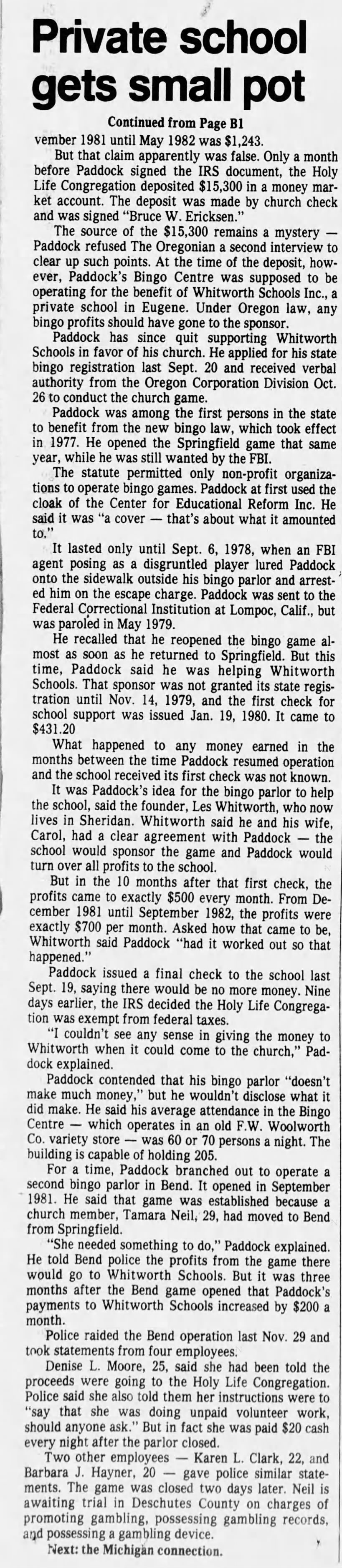
A lengthy article featured in an October 1981 issue of "The Bulletin" would describe Benjamin's next venture: "Bend's new bingo parlor is the brainchild of former FBI "most wanted" fugitive who frankly admits he became a mail order minister to take advantage of Oregon's gambling laws." [89] He would get ordained through the Universal Life Church, Inc., based out of Modesto, California, a church known for ordaining friends and family for weddings and events. Benjamin, would then go on to found his own religious practice/church, the Holy Life Congregation, located at 745 NW Bond Street. Holy Life Congregation would find itself consistently under the eye of the law, starting soon after the opening due to legal technicalities with its running of bingo games out of the location. To escape the eye of the law, just for a moment, Benjamin would rename the location to The Bingo Center, with profits being routed through Whitworth Schools, inc., to the Delphian School of Eugene, for a short time before closing the location and opening a new Bingo Center back in Springfield.
The Delphian School, according to their FAQ, itself is fully independent and not affiliated with any religious organizations, but as they state, "Delphian has become incorrectly termed a "Scientology school" by some online news sites." This is due to the use of "Study Technology," a method of study invented by the founder of Scientology, L. Ron Hubbard. With "Study Technology" being a cornerstone of the Delphian School approach, their curriculum further teaches Hubbard's philosophy through works such as "The Way to Happiness." [104,105] Founder of the Whitworth Schools, Inc., Les Whitworth claimed they had an agreement with Benjamin that the schools would sponsor games and The Bingo Center would return the profits to the school. Benjamin, seemingly "cooking the books" had worked it out so the checks were always exactly $500 or $700 a month. This, along with a mysterious $15,000 deposit into the Holy Life Congregation, would catch the eye of the IRS for an investigation ending with the Holy Life Congregation being deemed tax exempt. Following this, they would drop any funding to other schools or organizations and collect the profits themselves.
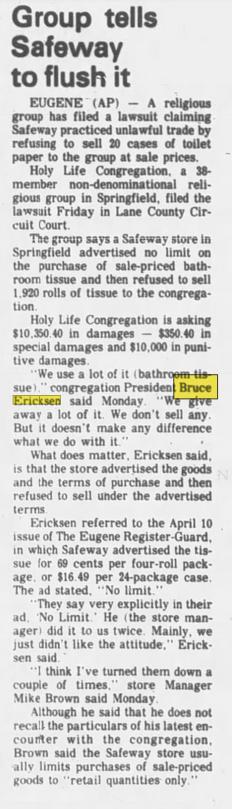
In 1985 Benjamin and the Holy Life Congregation would open a lawsuit against Safeway for the refusal to sell toilet paper in bulk quantities at sale prices. [92]
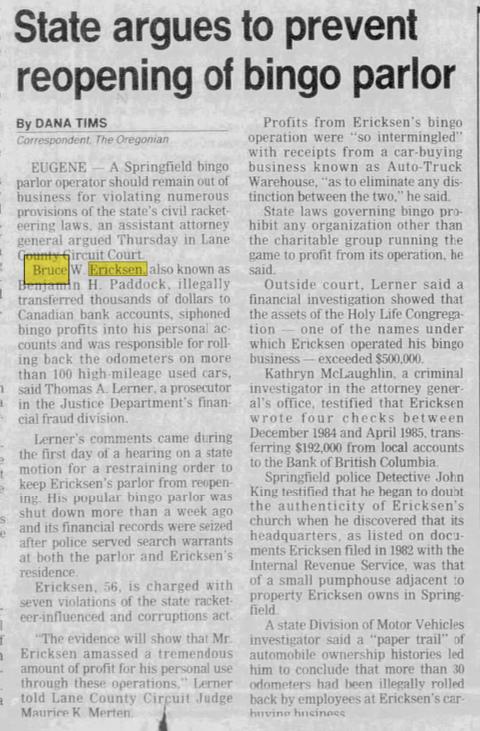
Eventually, in 1987, Paddock would face a maximum fine of $1.75 million for seven violations of the state racketeering act. These charges, opened by the state attorney general, were filed against several bingo operators using religious organizations as a guise, and an additional charge against Benjamin for an odometer rollback scheme on used trucks. Of course, Benjamin would claim their business was completely legitimate and had broken no laws during their operations. The affidavit would provide insight into the Holy Life Congregation's financials, with the church receiving around $320,000 and $218,000 (~$960,000 & ~$650,000 today) in 1985 and '86 respectively in deposits. The affidavit also describes Benjamin transferring assets out of the country within the last sixty days, taking $80,000 from a church-affiliated bank account and transferring it to Victoria, British Columbia. Paddock would claim this was because he was soon planning to retire to the area around the start of 1988 and start a new church. [93,94,95,96,97,98]
Benjamin, facing substantial fines, eventually settled the racketeering charges for $623,000 in May of 1988, and in November of that year paying another $100,000 in fees related to the odometer rollback scheme.
Arlington, Texas
1988 - 1999: End of Life
Following the racketeering charges, Benjamin would largely live the rest of his life quietly with his then partner, Laurel Paulson. The two would soon move out of the Eugene area and depart for Arlington, Texas. There, they would operate a used car dealership, as Benjamin had done many times in his past, and a machine shop, until his passing in January of 1998. As put by Don Bishoff in a 1998 obituary for Benjamin, "And then, in 1988, he was gone -- to Canada, supposedly; suffering from cancer, supposedly; broke, supposedly. . . But, Bingo Bruce Ericksen had moved to Texas." [99]
Benjamin Hoskins Paddock Jr. certainly lived a storied life. From starting a life of crime in Chicago, to remaining on the FBI most wanted list for nearly a decade, and later possibly working for the CIA, he really did get away with an awful lot. Given his involvement in gambling operations and potentially U.S. intelligence agencies, one can only imagine the influence his life and trajectory may, or may not, have had on his sons.
Closing Notes/Statement, Changelog
This biography, while I believe it to be a quite comprehensive biography on Benjamin Hoskins Paddock Jr., is still only a small slice of the life of an eccentric con-man. I would like this to be a living document, growing as I learn more about Benjamin and the spiders-web of his life. If I make any updates to this page I will catalog them below.
Changelog
- 10/01/2025: Initial publishing.
Sources
These sources are really most everything I personally have collected along with a good number of the sources from the newspaper archive on Benjamin dug up by Las Vegas Shooting Archive (LVSA - https://www.youtube.com/c/LasVegasShootingArchive, https://archive.org/details/benjaminpaddock). Intentionally, not all of my sources listed are directly cited within the text, this is because many are duplicates so I have grouped them where possible, and its simply (most) all of them that I have, chronologically, detailing Benjamin's life.
- 1. 1940 Census. Cook County, Chicago City, Ward 34, Block 2, House Number 4753. ↩︎
- 2. Chicago Tribune. "12 Auto Thefts Confessed by Former Seaman." January 8, 1946. 1946-01-08.jpg ↩︎
- 3. Fort Madison Evening Democrat. "Announce Nauvoo Girl's Wedding." August 25, 1952, p. 3. Archive.org ↩︎
- 4. Kansas City Times. "Two Charges Against Burk." January 22, 1953. 1953-01-22-KCTimes.jpg ↩︎
- 5. Springfield News-Leader. "Escapee Seized by Chicago Cops." February 8, 1953. 1953-02-08-SpringfieldNewsLEader.jpg ↩︎
- 6. Chicago Tribune. "Arrest Solves Father and Son Robbery Series." March 7, 1953. 1953-03-07-ChicagoTribune.pdf ↩︎
- 7. Kansas City Times. "Solution Is An Arrest." March 7, 1953. 1953-03-07-KCTimes.jpg ↩︎
- 8. Chicago Tribune. "Seize Ex-Convict Sought in Gang Robberies Here." March 9, 1953. 1953-03-09-ChicagoTribune.jpg ↩︎
- 9. Kansas City Star. "Chicago Man is Arrested." March 20, 1953. 1953-03-20-KCStar.jpg ↩︎
- 10. Clinton Herald. "Stephen Paddock Birth Certificate." April 9, 1953. ClintonHerald.com StephenPaddock_BirthCert.jpg ↩︎
- 11. "Draw Long Terms". June 9, 1953. 1953-06-09.jpg ↩︎
- 12. Arizona Republic. "Bank Robbed of $11,210." February 20, 1959. Newspapers.com ↩︎
- 13. Arizona Republic. "Make-Believe Role as Victim Of Holdup Comes True For Teller." October 16, 1959. Newspapers.com ↩︎
- 14. Yuma Sun. "Tucson Man Charged with Bank Holdup." July 28, 1960, p. 1. Archive.org ↩︎
- 15. Tucson Daily Citizen. "Paddock Held Under Bond For U.S. Court," and, "'Big Daddy' Made Big Impact Here." July 29, 1960, p. 4. Archive.org ↩︎
- 16. Tucson Daily Citizen. "Probation Unit Shunned 'Big Daddy'." July 30, 1960, p. 5. Archive.org ↩︎
- 17. Phoenix Arizona Republic. "Suspect Asks for Counsel." October 11, 1960, p. 67. Archive.org ↩︎
- 18. Tucson Daily Citizen. "'Big Daddy' Will Face U.S. Court." October 26, 1960, p. 2. Archive.org ↩︎
- 19. US District Court Phoenix. Criminal Case No. 15713, Government's Exhibit 1. November 6, 1960. USDC-Phoenix-Criminal-15713-Governments-Exhibit-1.pdf ↩︎
- 20. Tucson Daily Citizen. "'Big Daddy' Trial On In Phoenix." December 28, 1960, p. 14. Archive.org ↩︎
- 21. Phoenix Arizona Republic. "Big-Hearted Guy Trial." December 29, 1960, p. 16. Archive.org ↩︎
- 22. Tucson Daily Citizen. "Paddock Defense Set Tomorrow." January 2, 1961, p. 4. Archive.org ↩︎
- 23. Phoenix Arizona Republic. "Witness' Tears Disrupt Paddock Trial." January 5, 1961, p. 25. Archive.org ↩︎
- 24. Tucson Daily Citizen. "'Big Daddy' Paddock Draws Big Sentence." January 6, 1961, p. 8. Archive.org ↩︎
- 25. United States v. Paddock. 302 F.2d 514 (9th Cir. 1962). Appeals attempt. Law.resource.org ↩︎
- 26. United States v. Paddock. 320 F.2d 624 (9th Cir. 1963). Appeals. Law.justia.com ↩︎
- 27. New York Times. "Ford Fund Helps Students Effort." July 26, 1968. NYTimes.com ↩︎
- 28. Purdue Alumnus. "Who's in Charge—IV The Students." May 1, 1969. Purdue.edu ↩︎
- 29. New Castle News. "Wanted By FBI." June 9, 1969, p. 8. Archive.org ↩︎
- 30. Cedar Rapids Gazette. "Bank Robber Put on FBI Wanted List." June 10, 1969, p. 5. Archive.org ↩︎
- 31. Oakland Tribune. "Bank Robber on Most Wanted List." June 10, 1969, p. 60. Archive.org ↩︎
- 32. Phoenix Arizona Republic. "Robber of Phoenix bank on FBI most wanted list." June 11, 1969, p. 123. Archive.org ↩︎
- 33. Waxahachie Daily Light. "FBI Places Paddock On Top 10 List." June 11, 1969, p. 3. Archive.org ↩︎
- 34. Clovis News Journal. "Wanted by FBI." June 12, 1969, p. 10. Archive.org ↩︎
- 35. San Rafael Daily Independent Journal. "Most Wanted." June 12, 1969, p. 36. Archive.org ↩︎
- 36. Kenosha News. "State man on FBI wanted list." June 12, 1969, p. 6. Archive.org ↩︎
- 37. Hamilton Daily News Journal. "Chrome Dome." June 13, 1969, p. 28. Archive.org ↩︎
- 38. Scottsdale Progress. "Benjamin Hoskins Paddock." June 17, 1969, p. 3. Archive.org ↩︎
- 39. Sikeston Daily Standard. "Escapee Joins FBI List." June 18, 1969, p. 20. Archive.org ↩︎
- 40. Escanaba Daily Press. "Chrome Dome." June 19, 1969, p. 10. Archive.org ↩︎
- 41. South Haven Daily Tribune. "'Baldy' Escaped Robber." June 24, 1969, p. 9. Archive.org ↩︎
- 42. Frederick News Post. "FBI Adds 'Con Man' To Top Ten Fugitives." June 26, 1969, p. 6. Archive.org ↩︎
- 43. "NSA-Allied Groups Open Meetings Today." August 16, 1969. 1969-08-16.jpg ↩︎
- 44. "Educational Revolution Series Due." October 2, 1969. 1969-10-02.jpg ↩︎
- 45. Press Telegram. "Feel Wanted?" May 22, 1970, p. 1. Archive.org ↩︎
- 46. Sheboygan Press. "City Native on FBI's '10 Most Wanted' List." June 2, 1970, p. 23. Archive.org ↩︎
- 47. Los Angeles Times. "National Student Assn. Struggles Without CIA." August 23, 1970. 1970-08-23.jpg ↩︎
- 48. The Argus. "New Left forms half FBI list." September 6, 1970, p. 3. Archive.org ↩︎
- 49. Delta Democrat Times. "Half of FBI's 'Top Ten' are political activists." September 6, 1970, p. 12. Archive.org ↩︎
- 50. Tucson Daily Citizen. "Ex-Tucsonian Makes FBI List of 10 Most Wanted." April 27, 1971, p. 16. Archive.org ↩︎
- 51. Greeley Daily Tribune. "FBI Provides Information On One of '10 Most Wanted'." August 5, 1971, p. 7. Archive.org ↩︎
- 52. Cedar Rapids Gazette. "This 'n that." September 5, 1971, p. 102. Archive.org ↩︎
- 53. Chester Delaware-county Daily Times. "Delaware County has own 'most wanted' fugitives list." September 28, 1971, p. 15. Archive.org ↩︎
- 54. Daily Review. "FBI fugitive list radically changed." October 20, 1971, p. 34. Archive.org ↩︎
- 55. Fort Pierce News Tribune. "Terrorists Torment The FBI." November 17, 1971, p. 35. Archive.org ↩︎
- 56. Woodland Daily Democrat. "Wanted." February 29, 1972, p. 16. Archive.org ↩︎
- 57. Shiner Gazette. "Benjamin Hoskins Paddock." March 2, 1972, p. 3. Archive.org ↩︎
- 58. Bluefield Daily Telegraph. "Wanted By The FBI." June 7, 1972, p. 40. Archive.org ↩︎
- 59. Cedar Rapids Gazette. "The Ten Most Wanted." June 14, 1972, p. 4. Archive.org ↩︎
- 60. "Search For A 'Top 10' Fugitive Turns To The Lafayette Area." November 5, 1972. 1972-11-05.jpg ↩︎
- 61. Independent Press Telegram. "Names on Want list back to 10." February 18, 1973, p. 6. Archive.org ↩︎
- 62. Childress Index. "Most wanted list can be expanded." February 18, 1973, p. 17. Archive.org ↩︎
- 63. Abilene Reporter News. "FBI List Has New Emphasis." February 18, 1973, p. 24. Archive.org ↩︎
- 64. Albert Lea Sunday Tribune. "Revolutionaries Dominate FBI's Most Wanted List." February 18, 1973, p. 24. Archive.org ↩︎
- 65. Anniston Star. "FBI's list of 'most wanted' levels off at 10." February 18, 1973, p. 29. Archive.org ↩︎
- 66. Florence Morning News. "FBI's Most Wanted List Not Bound to Only Ten." February 18, 1973, p. 5. Archive.org ↩︎
- 67. Athens Messenger. "FBI Most Wanted Fugitive List Level At 10." February 19, 1973, p. 14. Archive.org ↩︎
- 68. Northwest Arkansas Times. "FBI's 10 Most Wanted List Can Be Expanded If Needed." February 19, 1973, p. 23. Archive.org ↩︎
- 69. Newark Advocate. "Ten men are most wanted by FBI." February 19, 1973, p. 24. Archive.org ↩︎
- 70. Harlan Daily Enterprise. "Most Wanted List Leveled Off." February 19, 1973, p. 3. Archive.org ↩︎
- 71. Huron Daily Plainsman. "FBI's Most Wanted Fugitives List Levels Off." February 21, 1973, p. 18. Archive.org ↩︎
- 72. Sheboygan Press. "Paddock: After 5 Years He's Still On 'Most Wanted' List." March 7, 1974, p. 14. Archive.org ↩︎
- 73. WikiLeaks. "FBI Wanted Criminals Found in Australia." Cable. June 12, 1974. WikiLeaks.org ↩︎
- 74. Magid, Larry. "Mini-Manual For A Free University." 1974. ERIC.ed.gov ↩︎
- 75. "Decade of Activists." January 15, 1975. 1975-01-15.jpg ↩︎
- 76. Des Moines Register. "Could Stay Free Forever." August 4, 1975, p. 10. Archive.org ↩︎
- 77. San Antonio Express News. "The Ones That Got Away." November 23, 1975, p. 85. Archive.org ↩︎
- 78. Janesville Gazette. "5 From State 'Most Wanted'." December 23, 1975, p. 18. Archive.org ↩︎
- 79. In Re Conduct of Smith (Oregon Supreme Court 1981). Law.justia.com ↩︎
- 80. Kennebec Journal. "Mariner on 'Most Wanted' List." May 7, 1977, p. 13. Archive.org ↩︎
- 81. Oregon Journal. "Bingo Boom." September 29, 1977. 1977-09-29.jpg ↩︎
- 82. Oregon Journal. "Bingo Boom hits Oregon." September 29, 1977. 1977-09-29-1.jpg ↩︎
- 83. Oregon Daily Emerald. "Education reform mag isn't looking for labels." April 20, 1978. 1978-04-20.jpg ↩︎
- 84. Eugene Register-Guard. "Retired policeman remembers Paddock as 'a real smoothy'." August 19, 1978. Google Books ↩︎
- 85. Kenosha News. "FBI has game plan: Bingo!" September 8, 1978, p. 12. Archive.org ↩︎
- 86. Madison Wisconsin State Journal. "'Most wanted' state man jailed." September 10, 1978, p. 35. Archive.org ↩︎
- 87. Eugene Register-Guard. "Prison escapee to stand trial on bank charge." September 15, 1978. 1978-09-15.jpg ↩︎
- 88. Eugene Register-Guard. "Springfield gets its 'Big Daddy' back." July 19, 1979. Google News ↩︎
- 89. The Bulletin. "Bingo nearly busts in Bend." October 19, 1981. Google Books ↩︎
- 90. The Oregonian. "Ex-convict bingo convert wants to leave past behind." March 8, 1983. 1983-03-08.jpg ↩︎
- 91. "Private school gets small pot." March 8, 1983. 1983-03-08-01.jpg ↩︎
- 92. Corvallis Gazette-Times. "Group tells Safeway to flush it." July 3, 1985. 1985-07-03.jpg ↩︎
- 93. Eugene Register-Guard. "Illegal gambling charges filed." October 2, 1987. Google Books ↩︎
- 94. The Oregonian. "Attorney general targets profit-skimming operations." October 3, 1987. The_Oregonian_1987_10_03_22.pdf ↩︎
- 95. "State argues to prevent reopening of bingo parlor." October 9, 1987. 1987-10-09.jpg ↩︎
- 96. Eugene Register-Guard. "Bingo." October 10, 1987. Google Books ↩︎
- 97. Eugene Register-Guard. "Man convicted of racketeering." May 25, 1988. Google Books ↩︎
- 98. Eugene Register-Guard. "Man fined $100,000 in mileage scam." November 19, 1988. Google Books ↩︎
- 99. Eugene Register-Guard. "Bingo Bruce a pro at cons." February 9, 1998. Google News ↩︎
- 100. Wikipedia. "Benjamin Hoskins Paddock." July 29, 2025. Wikipedia.org ↩︎
- 101. Helen Kuzmanoff Obituary. Legacy.com ↩︎
- 102. "The Ford Foundation and the CIA" Ratical.org ↩︎
- 103. Larry Magid "About" page. LarrysWorld.com ↩︎
- 104. Delphian School FAQ. Delphian.org ↩︎
- 105. Delphian School Study Technology. Delphian.org ↩︎
- 106. Bruce Paddock Interview. YouTube. YouTube.com ↩︎
- 107. Monolithik. "Benjamin Paddock - The apples didn't fall far." October 9, 2017. WordPress.com ↩︎
- 108. Tagesspiegel. "The Paddock Puzzle." Tagesspiegel.de ↩︎